
Hardeman Parole and Probation Compared
A person can live in Hardeman County after release and still owe duties to the state or a court. Parole is conditional community release before a prison sentence expires. The Tennessee Board of Parole authorizes it, but the Tennessee Department of Correction, or TDOC, supervises it. A grant does not mean the person walked out that day. TDOC first requires an approved release plan, and some cases require pre-parole programs or other conditions.
Probation is ordered by a court. It may be imposed without prison or after split confinement, which combines a jail or prison term with community supervision. TDOC says a probationer must report within 48 hours after placement on probation or release from split confinement. The judgment is the best source for the term. The comparison below keeps the two paths distinct.
| Point | Parole | Probation |
|---|---|---|
| Who orders it | Tennessee Board of Parole | Sentencing court |
| When it begins | After approval, plan review, and actual prison release | As directed by the judgment, including after split confinement |
| Who supervises | TDOC community supervision | TDOC or the authority named by the court record |
| Best public starting point | FOIL status, Board record, and field office | FOIL status, judgment, and field office |
| How it ends | Expiration, discharge, or other lawful Board and TDOC action | Completion or discharge under the sentence and court record |
- Parole
- Conditional release from prison before sentence expiration.
- Probation
- A court-ordered sentence served in the community under stated terms.
- Discharge
- The recorded end of a custody or supervision obligation.
- Absconder
- A person alleged by the responsible agency to have stopped reporting or left supervision without approval.
Verify Hardeman Post-Release Supervision
The verification path starts with identity, not a status word. TDOC's Felony Offender Information Lookup, known as FOIL, covers felony offenders currently or formerly in state custody or supervision. It may show a photograph, incarcerated, probation, parole, or inactive status, location, offense, sentence, hearing status, and release information. A TOMIS or TDOC number is a stronger match than a name alone.
- Search FOIL with the most precise name or identifier available and complete the CAPTCHA.
- Compare the birth and identity details before opening a record. Do not merge people with similar names.
- Read status and location together. Parole or probation points to community supervision; incarcerated does not.
- Record the access date because FOIL can change. Then check the field-office directory for the assigned region.
- Call the listed office to confirm the correct reporting location. Do not assume a Whiteville prison determines that office.
- For probation, obtain the judgment or later completion entry. For parole, obtain the Board file or TDOC release record when exact authority matters.
The Hardeman County released-inmate search paths explain how to pair a county release timestamp with state and court records. FOIL is not the default source for a short local misdemeanor booking. The Hardeman County Criminal Justice Complex report and court file serve that county-jail event.
Important: A parole grant or eligibility date is not proof of actual release; plan approval, a certificate, and release processing may still be pending.
Hardeman Supervision Through District 60
Hardeman County is served within TDOC Community Supervision District 60. The verified directory does not list a separate Bolivar field office. District 60 spans ten counties, including Hardeman, and lists sites in Jackson, Somerville, and Covington. A person's approved residence and assignment control the reporting site. The prison's location does not.
The TDOC field-office directory is the source to check before travel. Its Hardeman service listing is also shown in the captured directory screen.
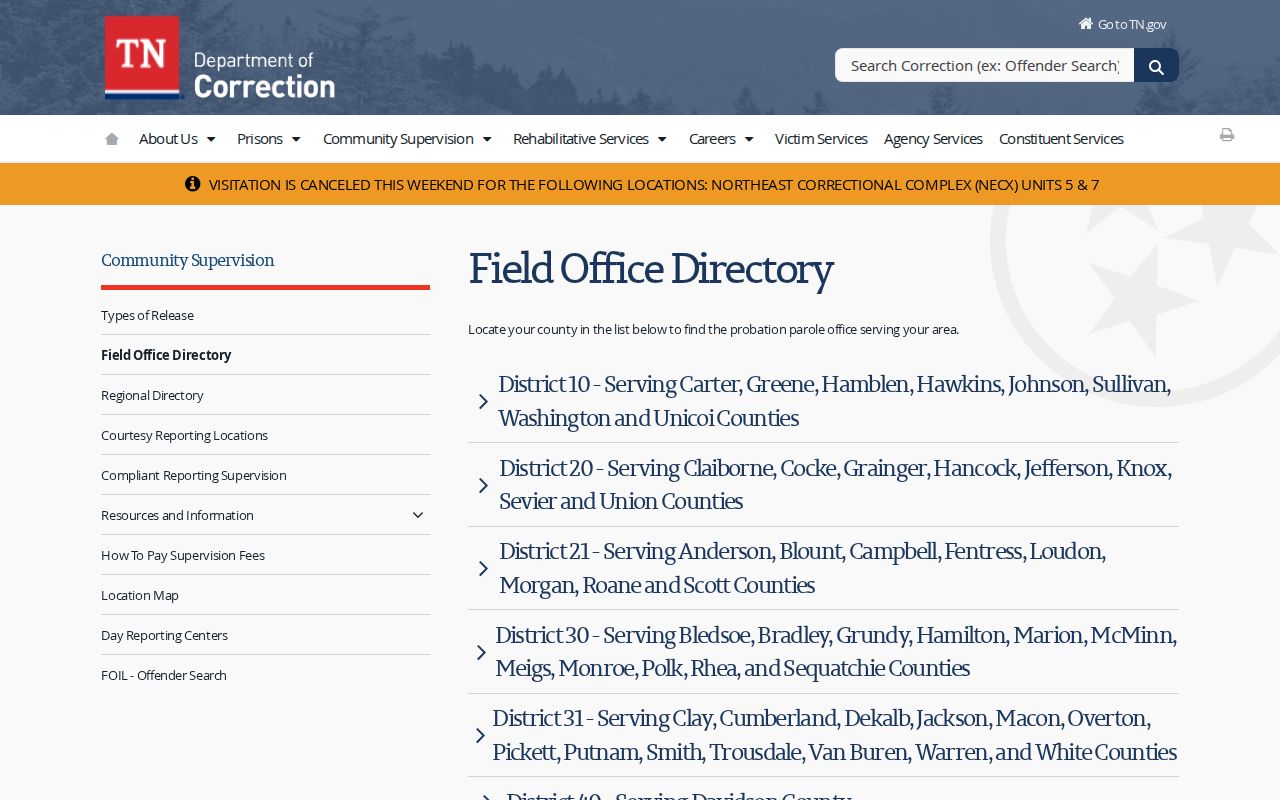
The directory proves regional coverage, but it does not disclose a person's private reporting schedule. Call the district office and provide enough identity information for staff to route the question.
TDOC District 60
District office
1661 Hollywood Drive
Jackson, TN 38343
731-984-9802
Other listed locations
12515 Highway 64, Somerville, TN
901-465-0558
105 Mueller Brass Road, Suite D, Covington, TN
731-341-6060
Note: Call before travel to confirm the assigned site; no verified directory entry labels a standalone Hardeman County or Bolivar supervision office.
Hardeman Parole Board Records
The Tennessee Board of Parole decides parole, while TDOC carries out supervision. Hearing officers gather facts and make nonbinding recommendations. Board members issue the final decision. A scheduled hearing only means the case will be considered. A grant can later be held up by conditions, plan review, or rescission before release.
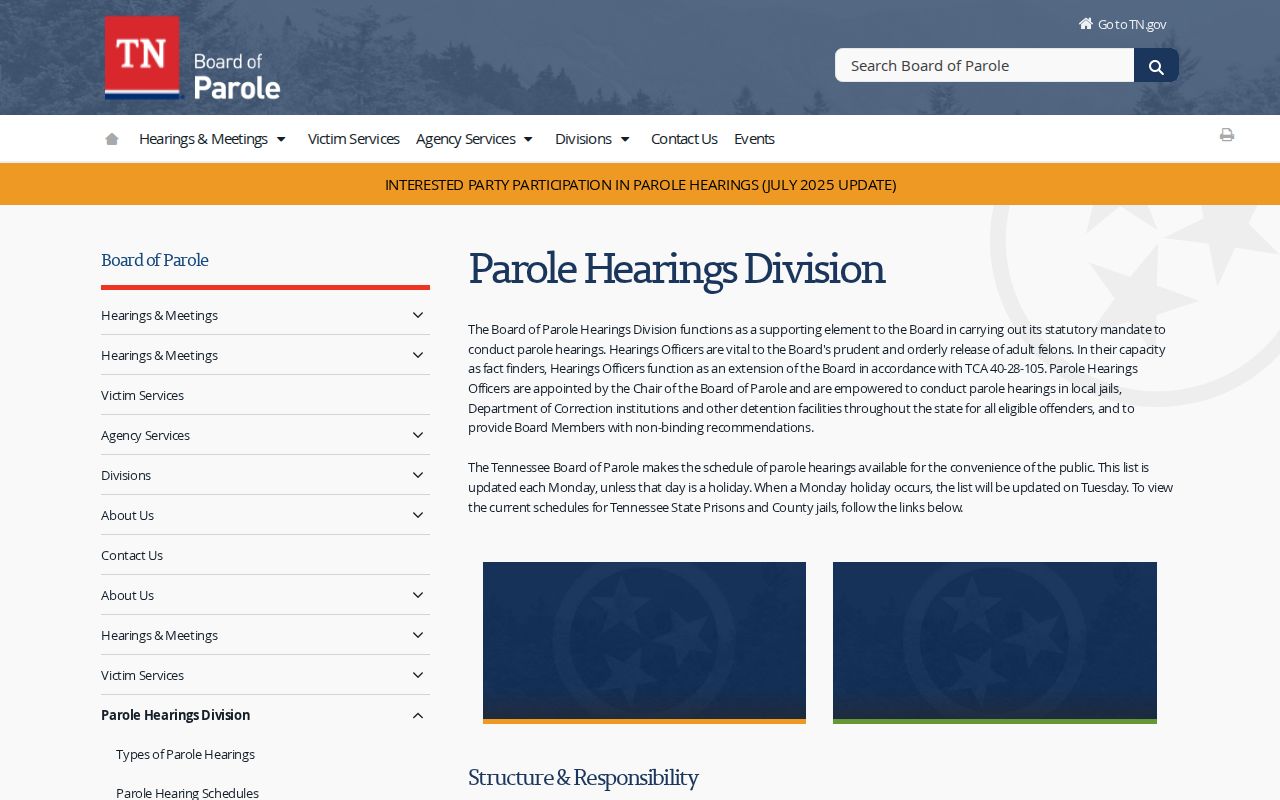
The Board's Parole Hearings Division says schedules are updated weekly on Monday, or Tuesday after a Monday holiday. The official screen documents that cadence.
FOIL may show hearing status, but no separate public statewide decisions database was verified. A nonconfidential Board file can document a grant, denial, deferral, revocation, reinstatement, or rescission. Contact the Board at 500 James Robertson Parkway, 4th Floor, Nashville, TN 37243-0850, 615-741-1150. Supply the full name and TOMIS number. Board Operations lists copies at $0.15 per page plus reasonable labor and audio at $10.
Hardeman Supervision Conditions and Violations
Conditions depend on the judgment, release certificate, supervision type, and individual case. They can govern reporting, movement, programs, payments, contact, or other conduct. The public record should not be used to infer private terms. Ask the supervising office or obtain the nonconfidential order when a precise condition matters.
An old charge labeled failure to appear or probation violation is not proof of a current violation or warrant. Hardeman County did not publish a verified current absconder or warrant list in the reviewed sources. An absconder finding must come from TDOC, the court, or the law-enforcement agency responsible for the warrant. A VINE custody alert can show a later custody change, but it does not decide whether a supervision allegation is valid.
Verification limit: A sheriff intake entry records an allegation from that booking episode, not present supervision status or an active warrant.
Note: Confirm urgent warrant or violation questions directly with the responsible office rather than relying on a dated PDF or cached search result.
Hardeman Reentry After Parole Release
TDOC requires an approved plan before parole release. That plan connects the proposed residence and supervision route to the actual departure process. Hardeman County has two state prisons, Hardeman County Correctional Facility and Whiteville Correctional Facility, but leaving either prison does not mean the person will report in Hardeman. Assignment follows the approved community destination.
No standalone Hardeman County reentry office was verified. The sound first contact is the assigned TDOC officer or District 60. TDOC also maintains statewide community resources through the Tennessee Reentry Collaborative. Institutional programs at the Whiteville prisons can support preparation, yet a program listing does not prove a release date or guarantee a local service slot. Confirm eligibility and availability with the program itself.
This distinction prevents a common error. The facility handles confinement, the Board decides parole, TDOC approves and supervises the plan, and a community provider offers its own service. Each record answers a different question.
Hardeman Release Supervision Types
Not every supervised release is parole or ordinary probation. Determinate release is a special probation mechanism for qualifying felony sentences under Tennessee law. Community corrections is a court sentencing alternative. Community supervision for life applies only to defined offenses under section 39-13-524. Mandatory reentry supervision may apply to covered felony offenses committed on or after July 1, 2021 under section 40-35-506.
The status label matters because eligibility, supervising authority, term, and end record can differ. Section 40-35-501 contains several release-eligibility structures and does not create one universal percentage. Read the judgment, FOIL entry, certificate, and TDOC record together. If the record says inactive, review the release and sentence information before treating it as full discharge from every possible system.
A specialized registry is also not a supervision lookup for all released people. The TBI Sex Offender Registry applies only to people with a legal registration duty. Its ACTIVE or INACTIVE-INCARCERATED labels may add context in those cases, but registry presence alone cannot prove the date of physical release.
Determinate release and mandatory reentry supervision can place a person in the community through rules that differ from a Board parole grant. That is why the title of the order or certificate matters. Ask which authority created the status, which office now has the case, and what record will show completion. A broad label such as “released” cannot answer those points. Hardeman County court records are useful for court-imposed terms, while TDOC holds the state supervision and sentence record.
Confirm Hardeman Supervision Discharge
Supervision ends through the authority that imposed or administered it. A probation judgment and later court entry can show completion. A parole or TDOC record can show expiration, discharge, revocation, or another change. A sentence expiration date should not be confused with the first day outside prison if the person served part of the term under supervision.
For a formal state record, ask TDOC Records Management for the release authorization, actual release date and type, sentence-expiration information, supervision status, and discharge record. Use the TOMIS number when known. Archived-record questions go to 615-253-8079, and TDOC advises requesters not to prepay because archive charges may be quoted. Keep the record date with any conclusion. A later jail intake or a different custody system will not always appear in the same state file.
When the claimed end date matters, request the narrow document that records it rather than every file connected to the offender. A completion order, discharge entry, or TDOC status record is easier to interpret and less likely to bury the answer. Compare the name and identifier across each source. Then state only what the dated record supports.