
Three Hardeman Release Date Milestones
A Tennessee prison record can carry several dates that answer different questions. Release Eligibility Date, or RED, is a calculated threshold for a release mechanism such as parole consideration under the applicable sentence law. Sentence expiration is the computed end of the imposed sentence. Actual release date is the completed physical departure recorded by TDOC. Calling all three a projected release date hides crucial differences.
A person may reach RED and be denied parole. The Board may grant parole, yet the person can remain confined while required programs or an approved plan are completed. Another person may leave prison under community supervision before sentence expiration. The actual release record is the only one of these sources that proves the physical departure event.
The date label should be copied exactly. If FOIL displays release eligibility, preserve that phrase and the access date. If a TDOC authorization displays release date and release type, those fields describe a completed event. Sentence expiration answers yet another question. Keeping the label intact lets a court clerk, TDOC records worker, or family member trace the conclusion back to its source without turning an estimate into fact.
- RED
- Release Eligibility Date, a legal eligibility threshold rather than a promised exit day.
- Sentence expiration
- The computed end of the sentence after applicable law and credits.
- Actual release
- The completed departure documented by the custody agency.
- Detainer
- A request or authority that may transfer or continue custody after one agency closes its case.
Hardeman Jail Versus Prison Dates
The Hardeman County Criminal Justice Complex is the county jail. Its sheriff report provides intake and release timestamps for booking episodes, but it does not promise a projected-date field. A person held before trial has no fixed sentence date. Bond action, a court order, a new charge, or a hold can change when release processing starts. Call Booking at 731-228-3016 for the live county status and use the court judgment for a local sentence.
Hardeman County Correctional Facility and Whiteville Correctional Facility are state prisons. Their release calculations belong to TDOC, even though both sit in Hardeman County and are managed under contract. The sheriff's monthly PDF does not track their departures. Use FOIL and TDOC sentence records instead. A move between prisons is a transfer, not an actual community release.
| Person or event | Correct date source | Main caution |
|---|---|---|
| Pretrial CJC detainee | Booking and court order | No fixed projected date may exist |
| County sentence | Judgment, jail credit, and Booking | Administrative processing or another hold may follow court action |
| HCCF or WCFA prisoner | FOIL and TDOC Sentence Information | RED is not actual departure |
| Completed state release | TDOC authorization or release record | Community supervision may continue |
Find a Hardeman Release Date
Start with the last known facility. This prevents a county-jail timestamp from being confused with a state prison calculation. The Hardeman County release search gives the broader path for identifying the correct custody system.
- For CJC, check the sheriff report for the booking episode. A populated release timestamp proves that episode ended, but it does not predict a blank row's future date.
- Call Booking when the report is old, the release field is blank, or a transfer and destination matter.
- For a state prisoner, open TDOC FOIL, complete the CAPTCHA, and search by TOMIS number or precise identity data.
- Read the exact sentence and release labels shown. Record RED as RED, not as a guaranteed actual release date.
- Compare the uniform judgment, offense date, sentencing provision, and concurrent or consecutive terms.
- If the computation is disputed, contact TDOC Sentence Information or request the specific sentence calculation and release authorization.
- After the expected date, check the new status and obtain the completed release record where proof is needed.
The official TDOC FOIL form is shown in the successful search capture.
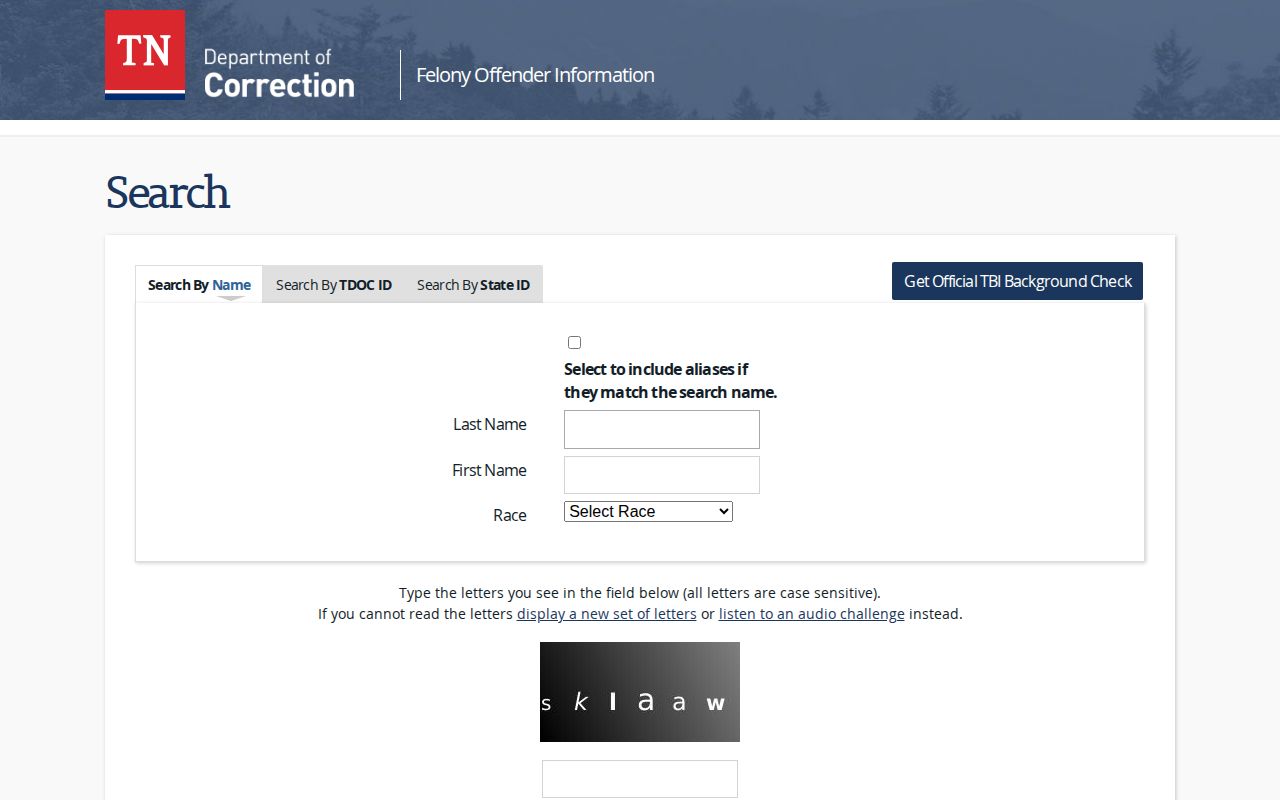
The form is CAPTCHA-gated and individual results can change, so save the access date with any field copied from a record.
Tennessee Credits and Hardeman Release Dates
Tennessee Code section 41-21-236 permits eligible sentence credits within statutory limits. The general framework allows up to 16 days per month, divided between institutional behavior and program performance. Credits are earned and administered under law and TDOC policy. They are not automatic. Certain discipline can cause credits to be withheld or removed, and security or segregation status can affect earning.
TDOC Policy 502.02 uses the term RED and states that loss of sentence credit can extend that eligibility date by the amount removed. Pre-sentence jail credit, program completion, corrections to the judgment, and the relationship between multiple sentences may also affect calculations. An outside calculator cannot see the full credit ledger or all legal terms.
The operator of a prison does not alter the governing rules. People at CoreCivic-managed HCCF and WCFA remain in the Tennessee state correctional system. TDOC is the computation authority. The official TDOC Sentence Information page supplies the state terminology used to interpret these dates.
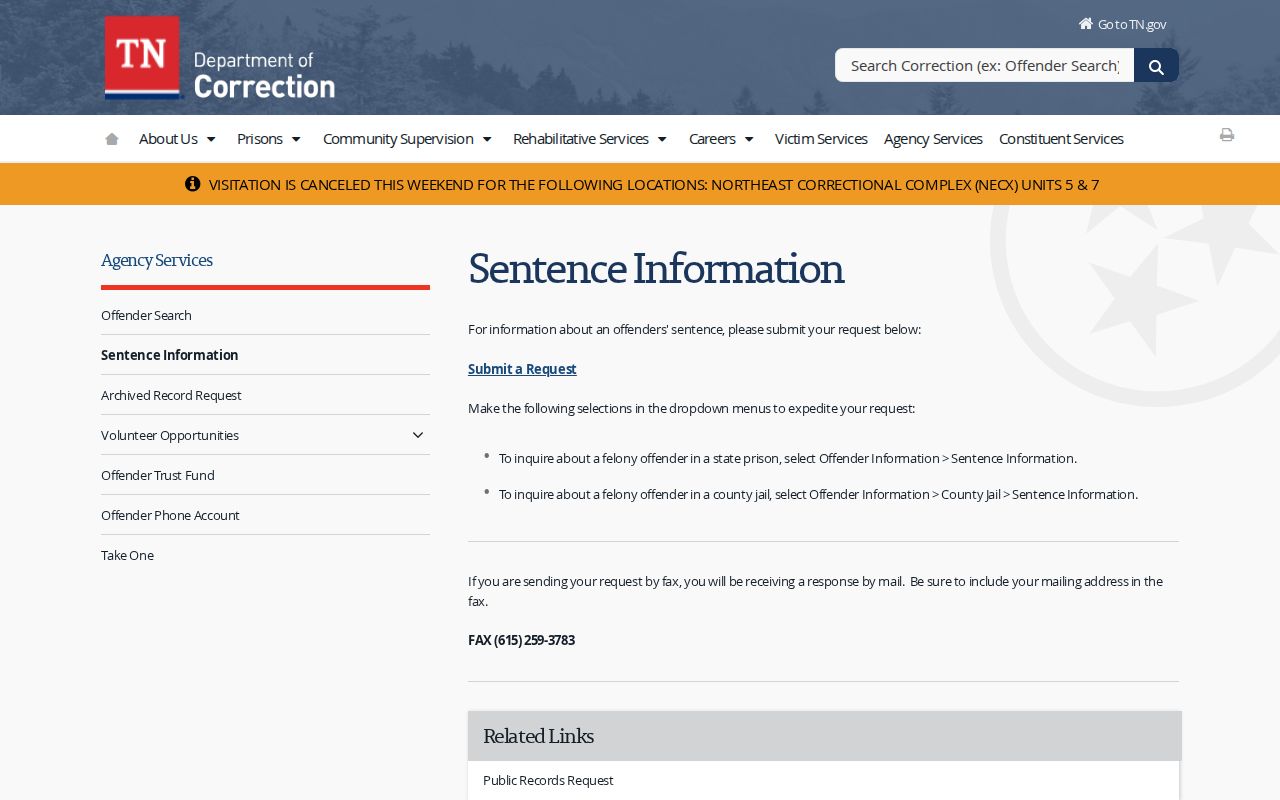
The captured source supports the distinction between legal sentence data and the day a release is actually processed.
Note: A credit estimate cannot replace the TDOC sentence computation because the public cannot see every award, loss, judgment change, or hold.
Hardeman Release Credits After 2024
Tennessee's post-July 1, 2024 distinction changes what credits can move. For offenses before that date, or later offenses with sentences under two years, credits may operate under the older sentence-reduction framework. For sentences over two years tied to offenses committed on or after that date, credits may advance parole eligibility without shortening sentence expiration.
This is the distinctive reason a single projected-release label can mislead. One record may contain an eligibility milestone that moves with credits and an expiration date that does not move in the same way. The offense date, sentence length, and legal provision must be known before anyone can say what a credit affected. A charge label from the sheriff intake report is not enough because an allegation is not the final conviction or judgment.
Obtain the uniform judgment and identify its release-eligibility box or statutory basis. Then compare it with FOIL and the TDOC calculation. This keeps a projected parole threshold from being reported as the end of the sentence.
Hardeman Release Percentage Limits
Public Chapter 988 created offense-specific structures for covered offenses committed on or after July 1, 2022. Certain listed offenses require 100 percent service without credit reduction. Another group is sentenced at 100 percent, but credits may reduce service no lower than 85 percent. Tennessee does not have one universal 85 percent rule for every prisoner.
The correct percentage turns on the convicted offense, offense date, judgment, sentencing range, and later controlling law. Section 40-35-501 contains multiple release-eligibility paths. Section 40-35-506 addresses mandatory reentry supervision for covered post-July 1, 2021 felony offenses. Neither statute converts RED into proof that a person left prison.
Hardeman County's sheriff PDF cannot resolve this issue. It records allegations and a county booking episode, not the final felony judgment used by TDOC. Even when a charge description resembles the later conviction, the judgment may contain a different offense, offense date, sentence range, or service provision. Use certified court terms when the calculation is disputed. Then ask TDOC to explain how those terms were entered into the sentence record.
A parole hearing date also proves only that consideration was scheduled. The Board may grant, deny, defer, revoke, reinstate, or rescind, and a grant still awaits the approved plan and actual processing. Read the final decision with the later TDOC status.
Why Hardeman Release Dates Change
Some events alter eligibility, some alter sentence expiration, and others affect only the day of actual departure. That difference explains why a person may remain at HCCF or WCFA after a date someone expected to be final.
| Factor | Possible effect | Best confirmation |
|---|---|---|
| Credits earned | May advance a qualifying eligibility date | TDOC credit and sentence calculation |
| Credit loss | Can extend RED by the removed amount | TDOC Policy 502.02 record |
| Jail credit correction | Changes credited time before prison | Judgment and TDOC computation |
| Concurrent or consecutive terms | Changes how sentences combine | Uniform judgments and sentence record |
| Parole denial or deferral | No parole release at the eligibility point | Board decision and FOIL |
| Incomplete plan or program | Delays actual departure after a grant | TDOC and Board documentation |
| Detainer or new sentence | May continue or transfer custody | Receiving agency and court record |
A status that remains incarcerated after an expected day does not reveal which factor applies. Ask TDOC Sentence Information rather than guessing. The institution can answer routine facility questions, but the central sentence record controls the calculation.
Administrative correction can also move a displayed date without a new court event. Save prior results with their retrieval dates, but treat the newest official computation as the current state view unless a judgment or agency correction shows an error. Where two official records conflict, give TDOC the TOMIS number, both labels, and the dates seen. A precise question is more useful than asking staff to estimate when someone will get out.
Confirm Hardeman Actual Release
Check the status again after the expected date. Parole, probation, or inactive in FOIL can indicate that state confinement ended, but read the full release and location record. A state release authorization can include the offender name, TDOC ID, conviction date, county, offense, release type, actual release date, sentence-expiration date, and limited intended-residence information. That event record is stronger than a forecast.
Tennessee VINE can provide time-sensitive custody-change alerts for TDOC. Registration should happen before the expected event. The Hardeman County VINELink check explains how to search one person and register. Treat a transfer alert as transfer, not community release. If exact authority or destination matters, obtain the TDOC record.
For archived documentation, contact TDOC Records Management at 615-253-8079 or write to Rachel Jackson Building, 2nd Floor, 320 6th Avenue North, Nashville, TN 37243-0465. Identify the person with a TOMIS number and request the sentence calculation, release authorization, actual date and type, sentence expiration, and any receiving detainer agency. TDOC says charges may apply and advises against prepayment until notice is sent.
Note: Preserve the retrieval date with FOIL and VINE results because both systems may change after a new custody or supervision event.